ISO 9001:2026 — What the New Edition Requires, and Why It Matters
ISO 9001:2026 is the international standard setting out the requirements for a quality management system. It defines what an organisation must have in place to consistently deliver products and services that meet customer, statutory and regulatory requirements, and to demonstrate that it improves on that performance over time. It is the standard organisations are certified against, and it applies to any organisation of any size in any sector.
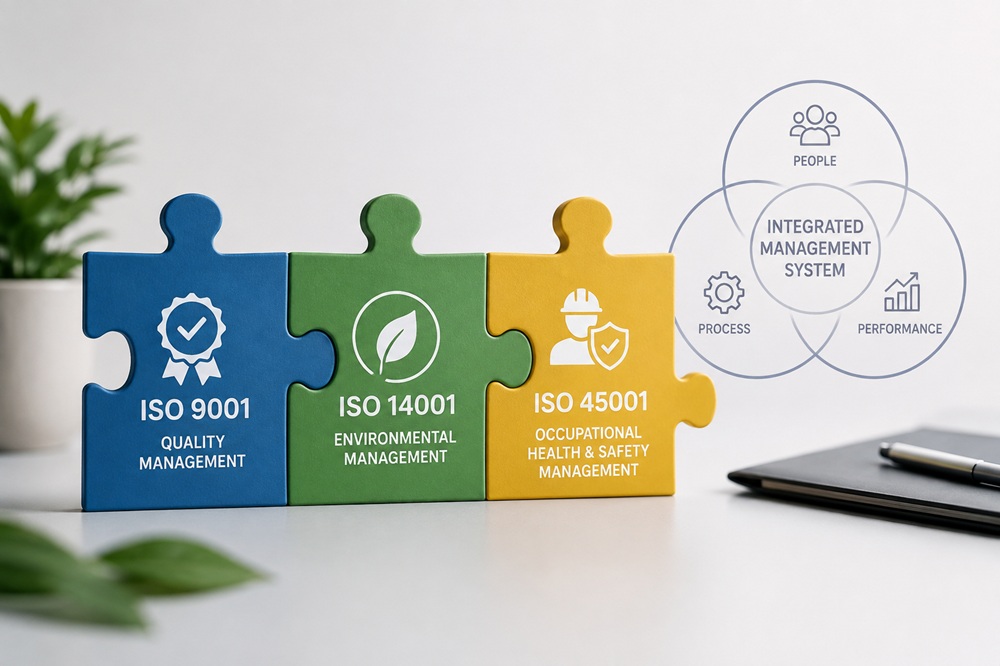
The sixth edition retains everything that made the standard workable. The process approach remains. The Plan-Do-Check-Act cycle remains. Risk-based thinking remains. The ten-clause Harmonized Structure remains, which is what allows ISO 9001 to be run as an integrated system alongside ISO 14001 for environment and ISO 45001 for occupational health and safety.
What has changed is the centre of gravity. The revision deliberately targets territory that quality professionals have argued over for a decade: organisational culture, ethical conduct, the practical difference between a risk and an opportunity, and whether climate change belongs anywhere near a quality manual. These are not clauses an organisation closes out by writing a procedure. They are clauses closed out with evidence of behaviour.
The Modifications at a Glance
The following summarises where the requirements text has actually moved. The overall extent of change is considered moderate, materially less disruptive than the move from the 2008 edition to 2015.
| Clause | What changed | Impact |
|---|---|---|
| Clause 3 | Terms and definitions reduced to a limited set, with the remainder referred out to ISO 9000. | Low |
| Clause 4.1 / 4.2 | The 2024 climate change amendment is now built structurally into the text. Interested-party expectations broadened beyond direct customers. | Moderate |
| Clause 5.1.1 | Top management must promote a quality culture and demonstrate ethical behaviour. | High |
| Clause 6.1 | Reorganised into sub-clauses 6.1.1 to 6.1.3, separating the determination of risks and opportunities from the planning of actions. Stronger opportunity-based thinking. | Moderate |
| Clause 6.3 | Reinforced requirements for planning and managing changes to the quality management system. | Moderate |
| Clauses 7.1.4, 7.2, 7.3 | Work environment, competence and awareness extended to cover quality culture and ethical behaviour. | High |
| Clause 8 | Minor terminology alignment only. The process approach is unchanged. | Low |
| Clause 9 | Minor refinements to performance evaluation, monitoring and management review. | Low |
| Clause 10.1 | Continual improvement consolidated from the former 10.1 and 10.3, with a broader framing that admits innovation and transformation alongside corrective action. | Low / Moderate |
| Annex A | New and substantially expanded interpretive guidance covering clauses 4 to 10. Informative, not normative. | High (indirect) |
The Changes Examined
1. Quality Culture and Ethical Behaviour
This is the headline change. Under the 2015 edition, culture was implicit, expected, gestured at in the leadership clause, but never named as a requirement. The 2026 edition names it directly. Top management is required to promote a quality culture and demonstrate ethical behaviour, and there is a corresponding awareness requirement so that people throughout the organisation understand what that culture means and how their own work contributes to it. Supporting provisions appear in the competence and work environment clauses.
The obvious question from any experienced auditor or auditee is how a culture is evidenced. The standard does not prescribe a method, which is both the difficulty and the point. In practice, organisations will demonstrate it through mechanisms that already exist in well-run businesses:
- A code of conduct that is genuinely referenced in decisions rather than filed;
- Values-based content built into induction and ongoing training, not bolted on as a separate module;
- Functioning speak-up, grievance and internal feedback channels with evidence of use and response;
- Recognition and performance schemes that reward quality outcomes rather than throughput alone;
- Visible consistency between what leadership states in management review and what leadership does when quality and schedule come into conflict.
That last point is the real test. A quality culture requirement is, functionally, a requirement that leadership decisions survive scrutiny. Where a delivery deadline has historically overridden a hold point or a release decision, that history becomes a conformity question rather than merely a cultural complaint.
2. Climate Change Within Organisational Context
Amendment 1 of February 2024 already required organisations to determine whether climate change is a relevant issue in their context, and whether relevant interested parties have climate-related requirements. That amendment is now woven into the body of the standard rather than appended as a note.
It is worth being precise about what this does and does not demand, because it is routinely over-read. ISO 9001:2026 does not require a decarbonisation plan, a greenhouse gas inventory, a net-zero target or ESG reporting. It requires a reasoned, documented determination of relevance: does "climate change, extreme weather, energy transition, emissions regulation, physical disruption in the supply chain, water stress" affect the organisation's ability to consistently deliver conforming product or service?
For a fuel terminal, a haulage fleet, a construction contractor or a coastal manufacturing plant in West Africa, the honest answer is usually yes, and the context analysis should show the reasoning. A determination that climate change is not relevant is acceptable, provided it is reasoned rather than assumed.
3. Separated Risks and Opportunities
One of the most persistent friction points in 2015 audits was that risks and opportunities were bundled into a single sub-clause. In practice this meant most organisations documented risks thoroughly and treated opportunities as an afterthought, typically as inverted risks, which is not what the standard intended.
The 2026 edition splits the planning clause into distinct sub-clauses, separating the determination of risks and opportunities from the planning of actions to address them, and expands the supporting guidance. Opportunity identification becomes a deliberate activity with its own inputs, evaluation and action trail.
Paired with the reinforced change-management requirements, the planning clause now reads much more like a resilience clause than it previously did. For organisations with integrated systems, the change-management alignment with the parallel ISO 14001 revision supports a consistent approach to change governance across both standards.
4. Awareness, Competence and Work Environment
The support clauses extend awareness beyond the quality policy, objectives and the consequences of nonconformity. Personnel must now also be aware of quality culture and ethical behaviour and understand how quality and ethics apply in day-to-day decision-making.
The implication is a training one. Organisations will need to go beyond procedural instruction and embed values and expected behaviours into onboarding, toolbox talks and internal communication. For most organisations this is satisfied by a considered addition to induction material, training content and records, but the content has to be real, because auditors will test awareness by asking people, not by reading the register.
5. A Broader View of Improvement
The continual improvement requirements are consolidated, and the framing is widened. Improvement is no longer read narrowly as corrective action arising from nonconformity; it explicitly admits innovation, transformation and reorganisation as legitimate improvement activity. This is a clarification rather than a new burden, but it gives organisations firmer ground to present strategic initiatives as QMS improvement evidence.
6. Annex A — The Quiet Heavyweight
ISO 9001 has never before carried an interpretive annex of this scale. Roughly fifteen pages of guidance now sit behind clauses 4 to 10, clarifying structure, terminology and clause intent, and including an explicit statement that ethical behaviour forms part of the culture of quality.
Annex A is informative, not normative. A certification body cannot raise a nonconformity against it. But it will strongly shape how auditors interpret the clauses that are normative, and it is the fastest available route to understanding how the next audit will be framed. When the published standard arrives, read Annex A first.
What Did Not Make It In
A great deal was speculated about this revision, and much of it did not materialise. Managing client expectations on this point is worth doing early:
- No artificial intelligence or AI governance requirements;
- No mandated ESG or sustainability reporting;
- No supply chain resilience clause;
- No prescribed digital documentation, software or remote audit protocols.
The standard remains deliberately technology-neutral and sector-neutral, and the volume of requirements has not meaningfully expanded. For organisations hoping the revision would force modernisation, that is a disappointment. For organisations running lean quality functions, it is a reprieve. Either way it sets the realistic scope of the work ahead: this is an integration exercise, not a rebuild.
Transition: What Certified Organisations Should Do
Transition window
A three-year transition period is widely expected, placing the deadline at approximately September 2029. However, the transition period and its rules are set by the International Accreditation Forum, not by ISO. Until the IAF resolution is formally issued, treat 2029 as a planning assumption rather than a confirmed deadline, and follow your accreditation and certification bodies for the binding announcement.
Certificates issued to ISO 9001:2015 remain valid throughout the transition period. No organisation loses certification on publication day.
The risk in a three-year window is not that organisations move too slowly. It is that they do nothing for thirty months and then attempt the entire transition in a rush ahead of a recertification audit. A staged approach avoids that.
- Obtain the published standard and read Annex A first. Do not transition against draft summaries, circulating comparison tables or secondhand interpretations, including this article.
- Run a targeted gap analysis. Focus on four live areas: context and climate relevance; leadership, culture and ethics; risks versus opportunities; and awareness and competence. The operations clause will almost certainly need nothing beyond reference updates.
- Treat culture and ethics as an evidence problem, not a documentation problem. Inventory what already exists, codes of conduct, inductions, toolbox talks, grievance channels, recognition schemes — and ask what would convince a sceptical third party that it functions in practice.
- Update the context analysis to record the climate relevance determination explicitly, with reasoning stated either way, and extend the interested-party analysis beyond direct customers.
- Rework the risk register so opportunities carry their own identification, evaluation and action trail rather than appearing as inverted risks.
- Retrain internal auditors before transitioning, not after. An internal audit programme still written against 2015 clause numbering and checklists will not surface the gaps that matter.
- Revise the quality policy and objectives so their alignment to organisational context and strategic direction is demonstrable.
- Agree the transition audit date with the certification body early. Audit capacity across the sector will tighten sharply in the final eighteen months, as it did during the 2015 transition.
For integrated management systems
Organisations running ISO 9001 alongside ISO 14001 and ISO 45001 should sequence this deliberately. ISO 14001 is revising on a comparable timeline, and the shared treatment of context, climate, change management and leadership makes a single combined gap analysis considerably more efficient than three sequential ones. Where an integrated system already exists, transition the common clauses once.
The Essence of It
Strip away the clause numbers and ISO 9001:2026 makes a single argument: that quality outcomes are produced by organisational behaviour, and that behaviour is a legitimate object of a management system rather than a fortunate by-product of one.
For three decades the standard has been criticised — often fairly — for certifying documentation rather than performance. Naming culture and ethics as requirements is the committee's answer to that criticism. It is an imperfect answer, because culture resists auditing and the requirement will inevitably be met with thin evidence in some quarters. But it moves the centre of gravity, and it aligns quality management with the broader governance expectations that customers, regulators and financiers are already applying independently of ISO.
For organisations in energy, construction, logistics and manufacturing, where the gap between the documented system and the system as practised, tends to be widest, that shift is the part worth preparing for. The clause changes take weeks of work. The cultural evidence takes considerably longer, which is precisely why the transition window is three years and not one.
This article is based on ISO/TC 176/SC 2 communications and published analysis of the approved Final Draft International Standard. Clause references should be confirmed against the published edition. Transition arrangements remain subject to formal confirmation by the International Accreditation Forum. This article is commentary and does not substitute for the standard itself, which should be purchased from ISO or your national standards body.