
Environment and sustainability
14001:2026 – Key Changes from ISO 14001:2015
ISO 14001:2026 replaces the 2015 edition with a stronger focus on environmental performance, climate change, biodiversity, resource efficiency, risk management and business integration. Here’s what organizations and environmental professionals need to know about the key changes and transition
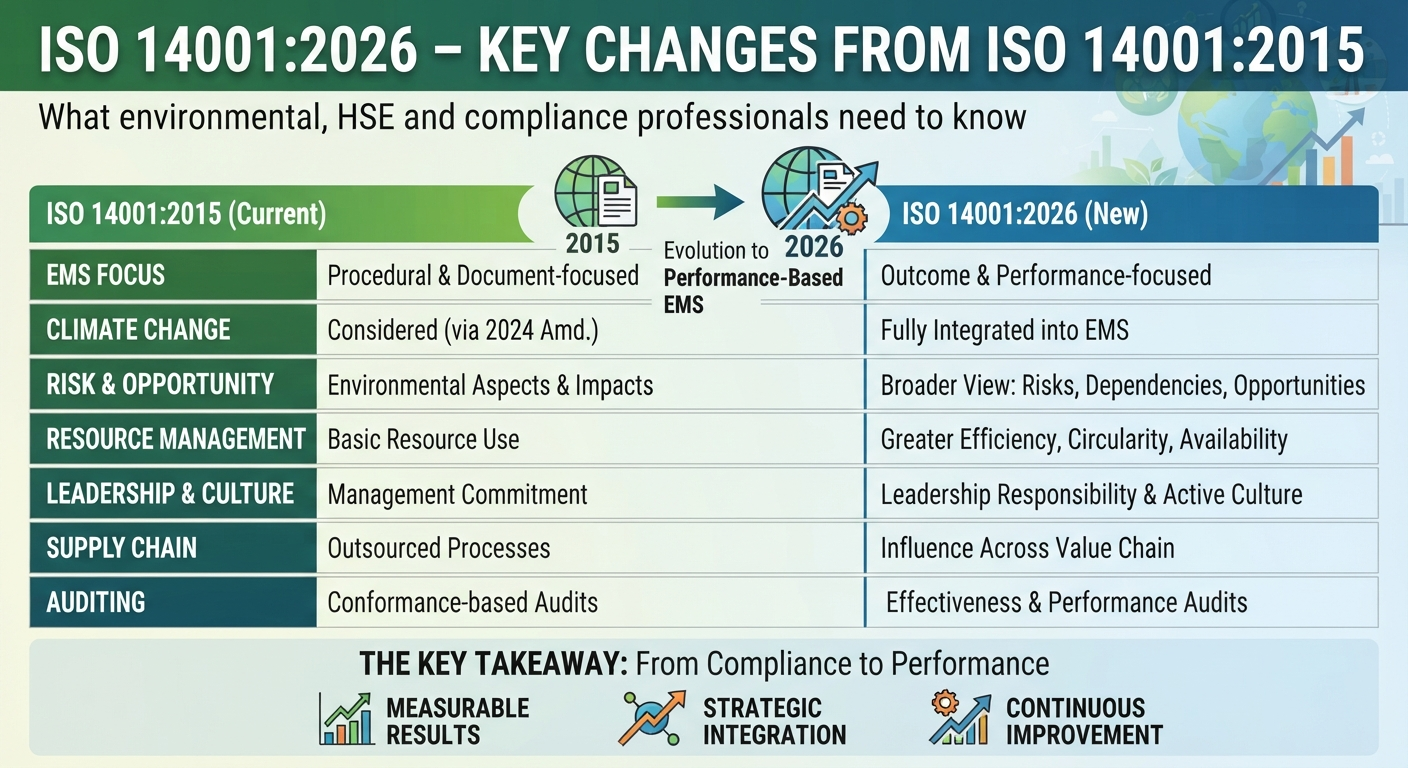
ISO 14001:2026 – Key Changes from ISO 14001:2015
What environmental, HSE and compliance professionals need to know
The publication of ISO 14001:2026 – Environmental Management Systems marks an important update to the international standard for environmental management. It replaces ISO 14001:2015 and incorporates the climate-change direction introduced through the 2024 amendment.
Importantly, ISO 14001:2026 is not a complete rewrite. The core Environmental Management System (EMS) framework remains, but the revised standard places stronger emphasis on environmental performance, climate change, biodiversity, resource availability, risks and opportunities, leadership and business integration.
What Are the Key Changes?
1. Stronger Focus on Environmental Performance
The emphasis is increasingly moving from simply having documented environmental processes to demonstrating that the EMS is actually delivering environmental results.
Organizations should be able to demonstrate measurable improvement in areas such as resource use, pollution prevention, waste, emissions, compliance and environmental risk control.
2. Climate Change Is Embedded in the EMS
Organizations need to consider whether climate change is relevant to their context and ability to achieve the intended results of the EMS.
This can include extreme weather, flooding, drought, water availability, resource constraints, operational disruption and the organization's own contribution to climate change.
3. Greater Attention to Biodiversity and Ecosystems
Biodiversity loss and ecosystem health receive greater attention in the revised standard. This is particularly relevant to sectors such as mining, construction, agriculture, energy, infrastructure and oil and gas.
Organizations operating near sensitive ecosystems should consider how their activities affect biodiversity and how their operations may depend on environmental resources and ecosystem services.
4. Resource Efficiency Matters More
Environmental management is increasingly connected with efficient use of water, energy, raw materials, fuel and other resources.
Reducing environmental impacts can also create direct business benefits through lower costs, improved efficiency and reduced operational risk.
5. Stronger Risk and Opportunity Management
Organizations should consider both environmental risks to the business and environmental risks created by the business.
For example, water scarcity may be a business risk, while excessive water consumption may be an environmental impact. At the same time, water-efficiency initiatives can become an environmental and financial opportunity.
6. Environmental Considerations in Change Management
Environmental implications should be considered when introducing significant changes such as new equipment, chemicals, processes, facilities, technologies, expansion projects or suppliers.
Environmental professionals should therefore be involved early in the change-management process—not only after implementation.
7. Greater Attention to Contractors and Suppliers
Environmental risks do not stop at the organization's physical boundaries. Contractors, suppliers, transporters, waste-management companies and other external providers can significantly influence environmental performance.
Organizations should therefore strengthen environmental requirements within procurement, contractor management and supplier controls.
8. Leadership and Environmental Culture
Environmental management is not solely the responsibility of the Environmental or HSE Department.
Top management needs to integrate environmental considerations into business decisions, resource allocation, objectives, risk management and strategic planning.
Environmental culture should also be demonstrated through employee behaviour, contractor performance and everyday operational decisions.
9. Internal Audits Should Focus on Effectiveness
Internal audits should go beyond checking whether procedures and records exist.
Auditors should ask:
- Is the process implemented?
- Is it effective?
- Are compliance obligations being met?
- Are environmental objectives being achieved?
- Is environmental performance improving?
ISO 14001:2015 vs ISO 14001:2026 – At a Glance
| ISO 14001:2015 | ISO 14001:2026 |
|---|---|
| EMS-focused | EMS with stronger performance focus |
| Climate considerations strengthened by 2024 amendment | Climate considerations integrated into the revised standard |
| Environmental aspects and impacts | Aspects, impacts, risks, dependencies and opportunities |
| Resource considerations | Greater emphasis on resource availability and efficiency |
| Environmental management | Stronger integration with business strategy |
| Outsourced processes | Broader focus on externally provided processes, products and services |
| Internal auditing | Greater focus on audit effectiveness and performance |
What Should Organizations Do Now?
Organizations currently operating ISO 14001:2015 should begin a structured transition assessment rather than waiting for their next certification audit.
- Review the requirements of ISO 14001:2026.
- Conduct a clause-by-clause gap assessment.
- Review organizational context, including climate change and biodiversity.
- Update environmental aspects, impacts, risks and opportunities.
- Review environmental objectives and KPIs.
- Strengthen contractor and supplier controls.
- Review change-management processes.
- Evaluate the effectiveness of internal audits.
- Review management-review inputs and outputs.
- Develop a documented transition plan.
The Key Takeaway
ISO 14001:2026 is more than a documentation update. It reinforces the need for organizations to connect their Environmental Management System with real environmental performance, business resilience and strategic decision-making.
The direction is clear:
From compliance to performance.
From documentation to evidence.
From environmental department to leadership responsibility.
From site boundaries to the wider value chain.
For organizations in mining, construction, manufacturing, energy, logistics and infrastructure, now is the right time to assess the current EMS and prepare for the transition to ISO 14001:2026.
Do not wait for the certification audit to identify your gaps. Start your transition assessment now.
Share this
Related reading